Fed Survey shows that low income earners experienced largest growth in household income between 2016 and 2019
Every three years the Federal Reserve publishes a Survey of Consumer Finances which reports trends on income and wealth. According to the most recent survey, which covers the period between 2016 and 2019, families saw positive income gains before the coronavirus pandemic. Additionally, those with lower incomes saw disproportionately larger gains.
As reported by The Wall Street Journal,
U.S. families’ income and wealth rose in the years heading into the coronavirus pandemic, with those in lower-income and lower-wealth categories reaping relatively large gains, the Federal Reserve said in a report on household finances.
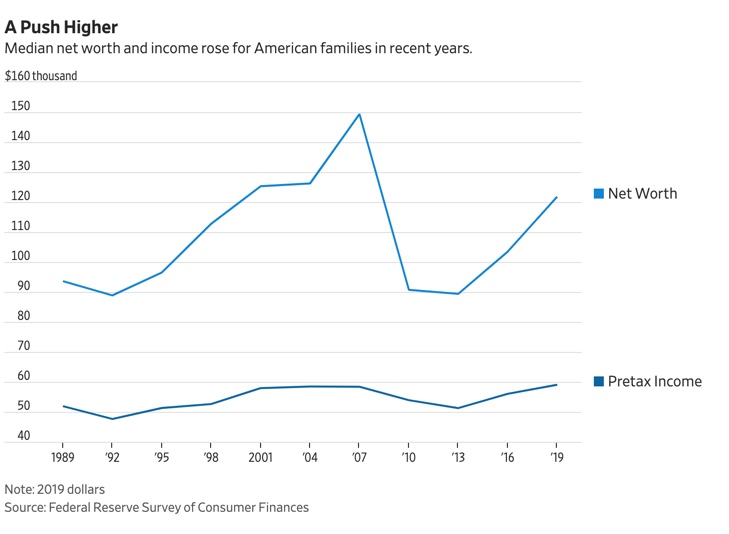
As property and stock prices increased, households’ median net worth, or wealth, rose 18% to $121,700 from 2016 to 2019,…..
Median household income—the level at which half are above and half are below—rose 5% to $58,600, before taxes and adjusted for inflation. The rise in incomes came as the economy grew 2.5% a year on average, inflation remained low and the unemployment rate fell.
Low-income individuals hugely benefited
According to the survey,
The distribution of wealth between low- and high-income households narrowed slightly in the latest survey period, Fed economists said, a shift from the 2010-to-2016 period when incomes largely stagnated for all but the most well-off after the 2007-2009 recession.
Families in the lowest two income groups recorded large percentage increases in median net worth, suggesting the decadelong expansion benefited a wide swath of society. Net worth rose 37% to $9,800 for the lowest earners, and increased 40% to $44,000 for the second-lowest group. The median net worth of the highest and second-highest groups declined 8% and 9%, respectively.
A Fed economist said home-ownership gains and rising home prices helped boost household net worth for lower earners.
Indeed data from the US Census Bureau also shows that Americans experienced tremendous income gains in 2018 and 2019, and poverty reached historic lows, thanks to a strong and growing economy.
Specifically, the 2016-2019 period was characterized by a tight labor market that “drew more low-skilled Americans into the workforce and spurred higher wages”. Americans also saw increased wealth due to a rise in savings among low-income groups, as well as increased homeownership due to rising incomes.
This has strong implications going forward
The coronavirus-induced recession has delivered a big blow to the economy. States are facing high unemployment and have to grapple with significantly reduced revenue forecasts. Small businesses are financially fragile and households, especially low-income households, are grappling with higher unemployment. Some of these gains, therefore, will likely be lost.
Nevertheless, this trend gives an idea of what it would take to bolster the economy, and that is not higher taxes or increased government regulations. Instead, the high growth period that we see was characterized by, among other things, lower taxes and deregulation. As the Wall Street Journal notes, while there were a lot of contributing factors to the pre-COVID-19 boom, Trump’s Tax cuts and other regulation policies were likely also major contributing factors.
States, therefore, mustn’t deviate from these small government principles, and enact policies stifling businesses and individuals in the name of mitigating negative outcomes from Covid-19.
We have perfectly seen that a growing economy delivers sustainable income gains to low-income individuals. A growing economy, however, has never been achieved by a growing government, burdensome regulation, or higher taxes.