What motivates families to switch schools?
I switched schools a handful of times throughout my K-12 education, and each time my parents had a very specific reason for doing so. Looking back, those experiences have made me curious about what drives other families to make the same choice.
Switching schools is not an easy decision, at least it wasn’t for my family, as there are a lot of factors to consider before doing so. And it is not a decision driven by the same reasons, as every family has its own educational priorities and concerns. That is the beauty of an educational marketplace; what motivates one parent to switch schools may be completely different from what motivates another.
In partnership with Morning Consult, EdChoice’s public opinion tracker surveys have worked to identify why parents decide to leave one school for another by providing them with a set of characteristics and asking them if their child’s previous school had any of them. “If they answer that the previous school had negative issues, we can intuit that they played a role in their school choice,” writes EdChoice’s Colyn Ritter for the Informed Choice substack.
The four issues parents most frequently cite are:
- Bullying
- Excessive stress or anxiety
- Difficulty with teachers
- Academic needs not being met
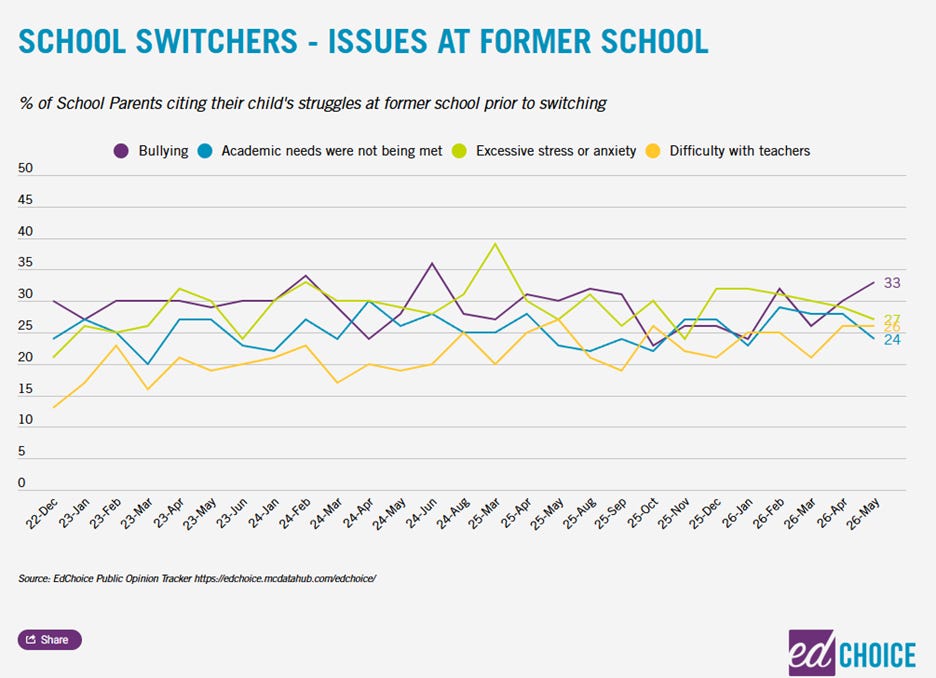
According to Ritter, this data, complemented by other reports EdChoice has published, “reveal an undeniable tendency among school switchers. That is, if a child’s physical safety or mental health is in question at their school, a parent will look to switch.”
But don’t completely ignore the academics issue, continues Ritter. “While parents are less likely to cite the issue of academic needs not being met compared to issues like bullying and excessive stress or anxiety, it remains one of the most frequently cited issues over time.”
One trend worth watching is the steady increase in parents citing difficulties with teachers. Ritter suggests this could indicate that parents are placing greater value on strong student-teacher relationships than they did in previous years.
In many school systems, families have limited ability to respond when a student is struggling with a teacher who may not be the right fit. In a choice-based system, families can vote with their feet, holding teachers and schools accountable in a way that forces the supply side of education to respond.
When my parents had me switch schools, it wasn’t done on a whim. Behind every data point in EdChoice’s tracker is a family making the same calculation mine did. School choice policies like tax-credit scholarships and Education Savings Accounts (ESAs) help ensure that those opportunities are available to more than just families who can afford to move or pay private-school tuition. As this survey data show, parents seek alternatives because their children have important needs that are not being met. Choice doesn’t eliminate those challenges, but it does give families the ability to respond to them.