Regulatory sandboxes could help improve entrepreneurship in Minnesota
Minnesota is struggling to create new businesses. In 2019, the state ranked 49th among the 50 states and D.C. for its rate of entrepreneurship per capita. And in the last 20 years, Minnesota has only exceeded the national entrepreneurship rate four times.
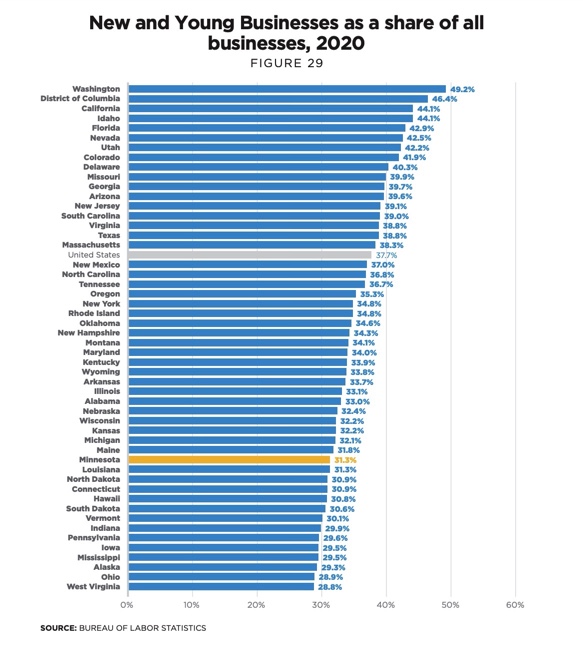
In 2020, Minnesota ranked among the bottom 15 states for its Business creation rate — or share of new and young businesses in the economy. Additionally, between 2000 and 2020, business creation declined by 4.6 percentage points. At the national level, however, the business creation rate declined 4.2 percentage points during the same period. Employment in new and young businesses has also been shrinking in Minnesota at a higher rate compared to most states and the national average.
This trend needs to be reversed, and regulatory sandboxes could help.
Regulation stands in the way of entrepreneurship
Startups are especially fragile and, therefore, sensitive to complex and overly burdensome rules. A 2019 study, for example, found that increasing the minimum wage is associated with lower business entry and higher exit rates for small businesses. This could be due to the fact that start-ups have low profit margins. By raising costs, minimum wage hikes make it even less feasible for them to operate. Similarly, other regulations like the occupational licensing act as a barrier to entry in low-income, low-risk occupations, deterring mobility and entrepreneurship.
Overall, when graded on numerous measures that affect entrepreneurship, Minnesota performs poorly. A 2020 Cato analysis, for instance, ranked Minnesota as the 39th least burdensome state for entrepreneurship. Arizona State’s Doing Business in North America Index also ranked Minnesota as one of the most expensive states for business.
Regulatory sandboxes can help
What are regulatory sandboxes?
According to the Libertas Institute, an organization that has been a principal driver in reforming Utah’s regulatory landscape,
A regulatory sandbox is a unique legal classification that creates space for regulators to temporarily freeze regulations and penalties. The process allows for private companies to develop or introduce an innovative product or service into a market space where current industry standards do not apply or are still being created.
Sandboxes are especially crucial in industries where innovation happens at a quick pace, such as the technology sector. When companies like Uber were created, regulation in the taxi industry was mostly fitting only for the traditional taxi model.
Uber’s model in many cities clashed with “decades-old taxi laws,” which, among other things, required driver licensing, training, and sometimes fingerprinting. Uber survived by advocating for the revision of outdated laws that impose stringent restrictions on companies with similar platforms.
How sandboxes operate
Sandboxes can be universal or industry-specific. And since they are experimental, sandboxes operate on a timeline. For example, Utah’s legal regulatory sandbox was initially set to run for two years. It has been extended to seven years.
In 2022, regulators in Utah will assess whether innovations have been harmful or beneficial to consumers and the economy, and also work to tailor/update regulations to fit the model of the new products as they transition to becoming fully licensed businesses.
This means that if every state had a regulatory sandbox when Uber was created, the company wouldn’t have had to expend so many resources to stay in business. Instead, Uber’s model would have operated for a while, later to be judged on its merit to consumes.
Minnesota would benefit from regulatory sandboxes
The U.S economy has been markedly changed by the coronavirus pandemic. For one, there has been increased digitalization in the economy, which might only continue going forward.
Enacting regulatory sandboxes in Minnesota would not only help improve entrepreneurship but would also increase the development of new and innovative goods and services more fitting to the changing economic landscape.