Childcare providers still face uncertainty
A recent survey by the Federal Reserve Bank of Minneapolis suggests that even though the pandemic is coming to an end, childcare providers are still uncertain about their future. While the factors that raised costs are going away, providers still face financial challenges stemming from the pandemic. Government programs, like expanded unemployment benefits, are not helping.
What happened during the pandemic
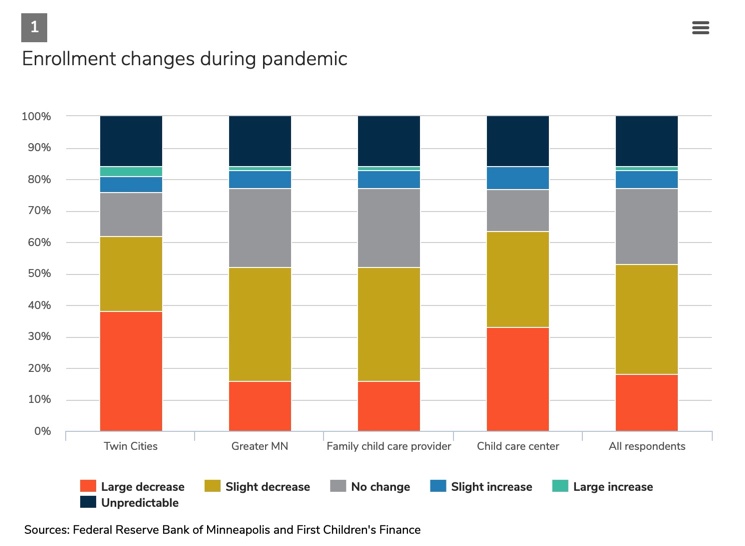
The pandemic brought a mixture of challenges for providers.
For one, numerous parents lost jobs and therefore had little need for outside childcare. Others simply feared contracting COVID-19 and also pulled their kids out of childcare. This caused enrollment to decline, reducing revenue. Additionally, the government mandated 10-person group limits, limiting revenue further.
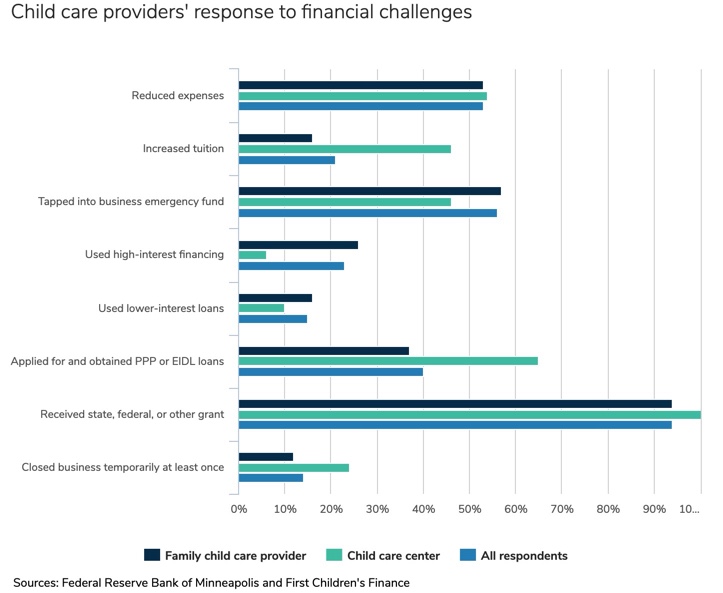
At the same time, however, costs for providing care were rising due to social distancing and cleaning requirements. Providers spent more money on cleaning products and extra staff to maintain smaller groups and smaller staff-to-child ratios. End result, some providers closed, and those that survived were kept alive through the combination of government assistance and owners taking extra measures like increasing tuition or taking on loans.
Challenges continue
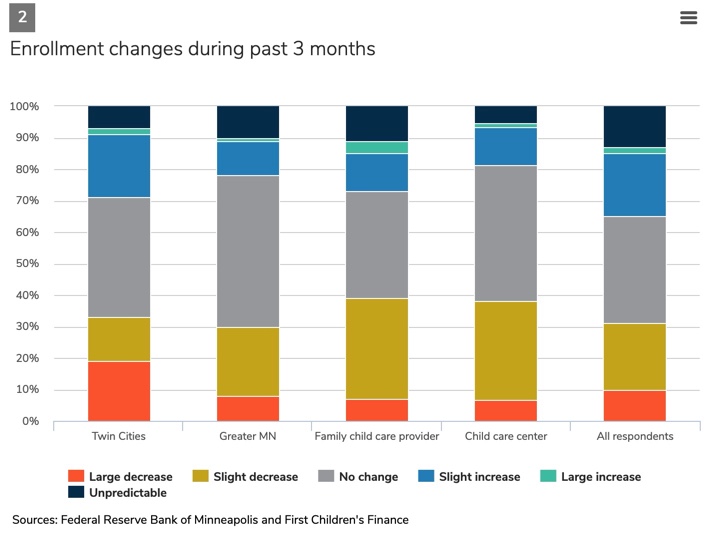
While enrollment declines reversed in the past three months, they haven’t gone away entirely, as shown by the chart below. It is no surprise that many providers are unsure of the survival of their business.
Some of this negative impact was inevitable at the onset of the pandemic. There is a potential that government action made things worse. According to the survey, some providers blamed expanded UI payments as one reason they were unable to hire workers.
Some respondents said their enrollment suffered because they had trouble retaining enough workers to maintain the staff-to-child ratios required by the state. This was already a concern before the pandemic, but respondents’ comments suggested it had gotten worse. The staffing issue primarily affected child care centers, with 57 percent reporting that they struggled to maintain appropriate staffing levels and 91 percent saying that hiring is difficult or very difficult for them. The vast majority of family child care providers don’t employ anyone.
Some providers blamed the supplemental unemployment benefits that came with federal pandemic aid, which made their wages less competitive. Others said their staff deserve better wages, but offering that was challenging even before the pandemic.
Childcare is a low-wage industry; however, expanded unemployment benefits make it hard for low-wage industries, usually service industries, to recruit workers. Childcare providers, much like businesses in the hospitality industry, cannot raise wages infinitely to attract talent. And besides, low wages in childcare are partly due to costly regulation that takes money away from staff to compliance activities.