Less-ducated people and recessions
COVID-19 has delivered a big blow to the U.S. economy. However, as I have written before, the cost of the COVID-19 recession has not been borne equally among U.S. residents.
Economically disadvantaged people, particularly low-income and less skilled workers, have been more significantly impacted. A new analysis of employment data by the Federal Reserve Bank of St. Louis shows that this is a recurring trend.
With the COVID-19 reception, workers with less than a high school diploma (25 and older) saw the largest downward shift in employment. Workers with a bachelor’s degree or higher, on the other hand, had the lowest shift in employment.
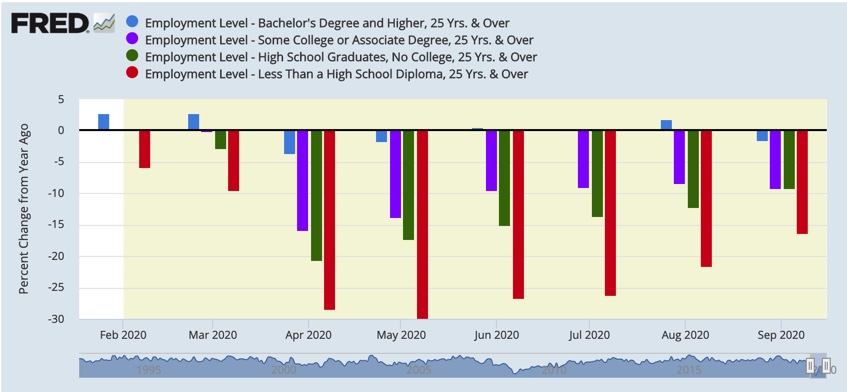
Source: Federal Reserve Bank of St. Louis
Similarly, during the 2008-2009 recession, workers with less than a high school diploma had the largest decline in employment.
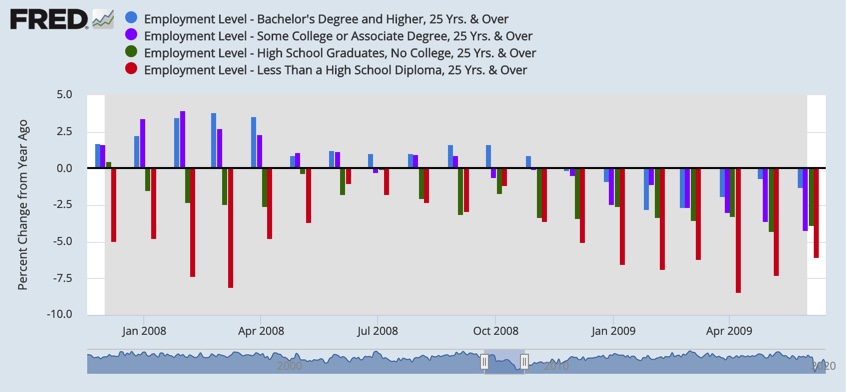
Source: Federal Reserve Bank of St. Louis
Policy implications
Why are less skilled (and, therefore, likely low-income) workers disproportionately vulnerable to recessions?
Less skilled workers tend to be overrepresented in the service sector or other non-specialized industries. These industries are generally more susceptible to economic downturns, which results in higher-than-average job and income losses. At the same time, low-skilled workers often lack the skills to find employment in alternative industries, which often results in prolonged unemployment. The COVID-19 shutdown specifically targeted those industries in which low-income, low-skilled workers were overrepresented, leading to this trend.
Policies that contract the economy, therefore, however well intentioned they may be, will likely always deliver the biggest blows to already disadvantaged individuals.