What does the Supreme Court ruling on LGBTQ+ curriculum mean for Minnesota?
The U.S. Supreme Court decision in Mahmoud v. Taylor last week found that a Maryland public school district violated the First Amendment’s Free Exercise Clause by refusing to let parents opt their elementary children out of reading lessons that included LGBTQ+ books.
Relying heavily on a decision made a century ago in Pierce v. Society of Sisters, the High Court reasserted that parents cannot be forced to have their children exposed to material that violates their religious beliefs. The public school district’s “LGBTQ+-inclusive” curriculum and “no-opt-out policy pursue the kind of ideological conformity that Pierce” prohibits, wrote Justice Clarence Thomas.
Parents with different religious objections, including Muslims, Jews, and Orthodox Christians, brought the suit after the Maryland school district initially allowed parents to opt-out of the LGBTQ+ books and instruction but then withdrew that option, citing administrability concerns. But Justices Samuel Alito and Brett Kavanaugh questioned why the opt-outs were not possible given their commonality in other schools and even in this particular district in other contexts (parents could opt-out their children from similar content in health and sex education in the county schools). Additionally, opt-outs for religious reasons make up a small portion of opt-outs, making them less of a burden.
What does this mean for Minnesota?
In Minnesota, state law already requires districts to have a procedure in place for a parent to review the content of the instructional materials provided to their child and, if the parent objects to the content, make “reasonable arrangements” with school personnel for alternative instruction. This not only applies to health and sex education but other classes as well.
Further, if the alternative instruction offered by the school board does not meet the concerns of the parent, that parent may provide alternative instruction. No repercussions or academic penalties can be imposed on the student for arranging alternative instruction.
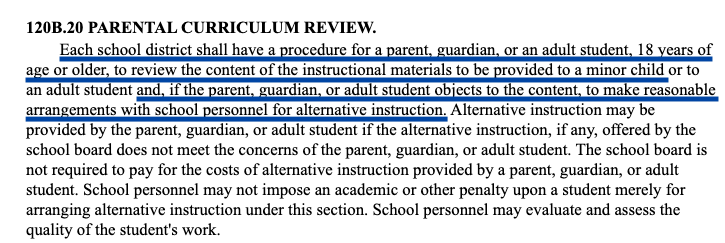
Parents may not be aware of this decades-old law or their district’s procedure for making “reasonable arrangements” for an alternative lesson. Those interested in learning more about their district’s policy on the matter can look in the 600 range — for example, the St. Louis Park school district’s 606 policy includes “Procedures for Objection to Instructional/Resource Materials,” such as parental alternative curriculum request forms and forms for citizens or community members to request reconsideration of curriculum.
In addition, Minnesota Statute 120B.11 requires school districts to provide for regular community review of the curriculum review process. While this requirement is broader, it still provides parental involvement in a district’s review and evaluation cycle for each subject area. Interested parents and community members can ask their school board about serving on the district advisory committee.

Parental rights, responsibilities, and values do not get surrendered at the schoolhouse door. Understanding these rights and knowing how to exercise them is an important part of playing an active role in your child’s education. Check out American Experiment’s Minnesota Parent Toolkit to learn more.
____________