Survey says: Parents are interested in new school options
Happy National School Choice Week! New survey results reveal that 60 percent of U.S. parents said they considered new or different schools for at least one of their kids last year. But few parents followed through and actually made the switch.
According to Andrew Campanella, CEO of the National School Choice Awareness Foundation, the disconnect is a sign that “particular barriers often prevent parents from following through, even when options are available. These include a lack of transportation, financial constraints, confusion over enrollment processes and simply a lack of time to apply.” Previous surveys have also suggested this.
The National School Choice Awareness Foundation’s Navigate School Choice online portfolio (also available in Spanish, Conoce tus Opciones Escolares) along with the work and resources of their network members are a handful of the organizations working to provide families with the information they need to explore their options, according to Campanella.
Communicating effectively with families and guiding them through the often overwhelming process of finding and enrolling in the best educational fit for their children is just as critical as policy advocacy.
The National School Choice Awareness Foundation’s January 2025 survey asked 2,873 parents of school-aged children a variety of questions related to considering, searching for, and choosing a new or different school or learning environment for their children last year.
What learning environments are parents considering?
Black moms and dads (68 percent), younger parents (71 percent), and military families (84 percent) were among the most likely to consider new schools last year for their kids.
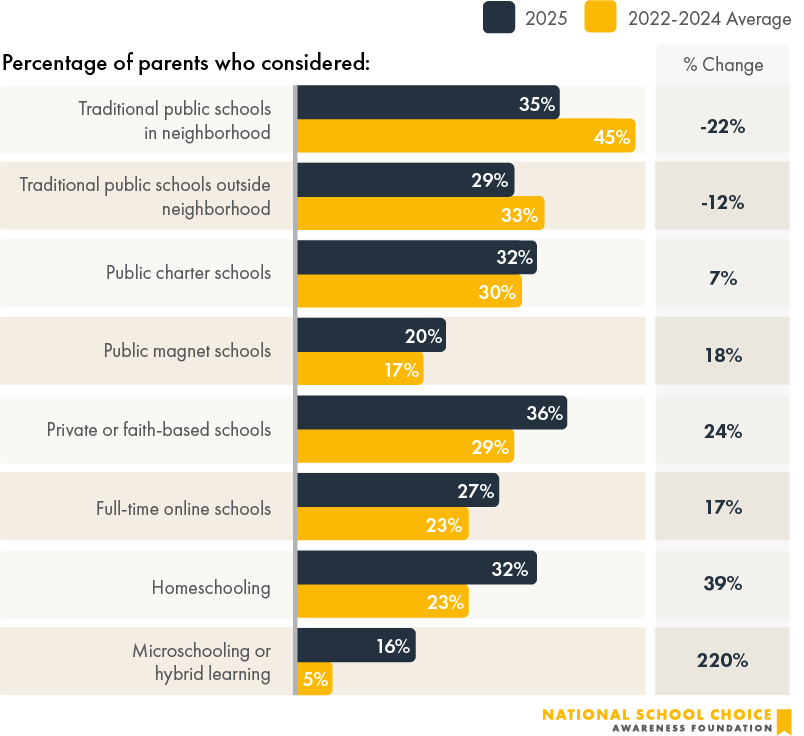
The percentage of parents who considered public schools was lower than previous years’ survey results, while the percentage of parents who expressed interest in private schools, homeschooling, and microschools increased from past surveys.
“After several years in which we saw overwhelming parent interest in traditional public schools, this year’s drop is curious but easily explained,” states Campanella.
With more parents searching for new schools each year, and with parents gaining an awareness of how school choice really works, families are running up against an unfortunate reality: too many states make it too complicated to choose public schools outside of zones or districts. Bureaucracy itself is a barrier –– not just to choice, but to demand. Meanwhile, the surge in demand for microschooling indicates that this small, personalized, and markedly less-bureaucratic approach to learning is more than just a passing fad.
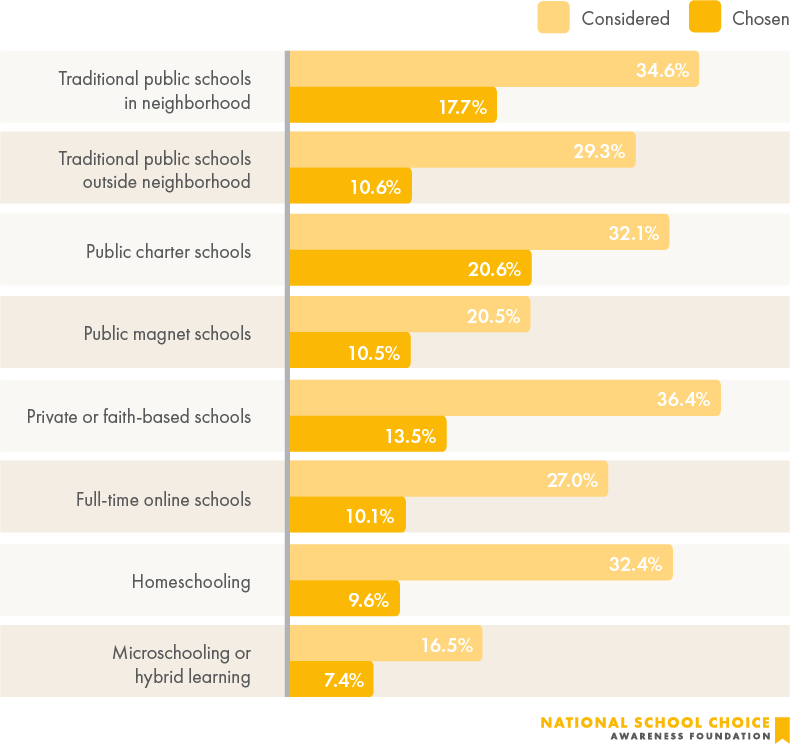
What learning environments are parents choosing?
Of the 28 percent of parents who searched for a new or different school and then made the switch, just under 60 percent chose a public school (traditional, charter, or magnet), 10 percent chose a full-time online school (public or private), and just over 30 percent chose either private schools, homeschooling, or microschooling.
“Even though parents told us that they considered private or faith-based schools more than any other type of school last year, and even with a spike in parent demand for these nonpublic options, the percentage of parents who enrolled their children in private-sector schools after considering them remains relatively low,” states Shelby Doyle, vice president of the National School Choice Awareness Foundation.
While families have different reasons for not making the switch, it “also highlights that expanding school choice in one sector of schooling is not a panacea for all families,” Doyle continues. “[M]any types of high-quality options are needed for every family to find the right fit.”
More than half (51 percent) of parents said they wished they had more information about the schooling options available for their children.