Minnesota can no longer hide in its averages
A serious look behind our state’s average achievement scores shows we aren’t doing as well as we like to think we are.
Comparing Minnesota’s average reading and math performance on the National Assessment of Educational Progress (NAEP) with other states’ NAEP scores shows Minnesota doing seemingly well — placing in the top seven highest scoring states for fourth-grade math, the top 28 for fourth-grade reading, the top three for eighth-grade math, and the top 14 for eighth-grade reading.
But Minnesota can’t continue to hide in its averages if we want to stop leaving students behind. States serve very different populations, and comparing states’ average NAEP scores ignores student heterogeneity and can miss — or overstate — how well a state and its policies serve its very different student populations.
That’s why the Urban Institute has, for nearly 10 years, published demographically adjusted NAEP results. Matt Chingos and Kristin Blagg calculated “how each individual student who takes the NAEP scores relative to students nationwide who are the same gender, age, and race or ethnicity and have the same free and reduced-price lunch receipt status, special education status, and English language learner status.”
The demographically adjusted results dramatically switch up Minnesota’s position on the leaderboard, moving it from being in the top seven highest scores for fourth-grade math to the top 26; from the top 28 highest scores for fourth-grade reading to the top 39; from the top three highest scores for eighth-grade math to the top 15; from the top 14 highest scores for eighth-grade reading to the top 31.
There’s a reason the Minnesota Department of Education’s announcement of 2024 state assessment data last August didn’t name math or reading proficiency numbers. “Test scores hold steady,” read the press release. “Across all grades and subjects, students who took the MCA [Minnesota Comprehensive Assessment] in 2024 scored about the same percent proficient as last year.”
And what were those percents? Less than half of students — 45.3 percent in math and 49.7 percent in reading, respectively — demonstrated grade-level numeracy and literacy skills, which are the same proficiency levels reported for 2023.
Education Minnesota’s January press release on the state’s 2024 NAEP test results used similar language as MDE, noting that “scores hold steady while national averages decline” as “Minnesota’s fourth and eighth graders who took the National Assessment of Educational Progress last year scored about the same as students in the same grades who took the test in 2022.”
It is true that Minnesota’s 2024 NAEP test scores are not significantly different from two years prior, but two years prior those results were the worst in decades. And the 2024 results are still below pre-COVID levels, despite the record-levels of federal aid intended to address steep learning loss. Fourth-grade reading and math have experienced steep score drops since 2019 (see charts below). The percentage of students without basic reading skills remains at an all-time high for fourth graders (39 percent) and is also now the highest level on record for eighth graders at 29 percent.
NAEP Fourth-Grade Reading
Score point difference from 2019 to 2024 by state

NOTE: Significant score differences were calculated and determined by the National Assessment of Educational Progress
NAEP Fourth-Grade Math
Score point difference from 2019 to 2024 by state

NOTE: Significant score differences were calculated and determined by the National Assessment of Educational Progress
According to a joint Harvard University/Stanford University project measuring K-12 learning loss in reading and math since COVID-19, Minnesota students today are about three-quarters of a grade level behind their 2019 math ability and more than half a grade level below in reading. (The analysis combined NAEP scores with district scores on state assessments to calculate the achievement loss.)
Minnesota is the 8th highest state in expected loss in lifetime income from interrupted learning, according to an analysis of NAEP scores by Stanford economist Eric Hanushek. Lower skills translate to future economic losses, Hanushek notes.
Extensive research demonstrates a simple fact: those with higher achievement and greater cognitive skills earn more. The evidence suggests that the value of higher achievement persists across a student’s entire work life.
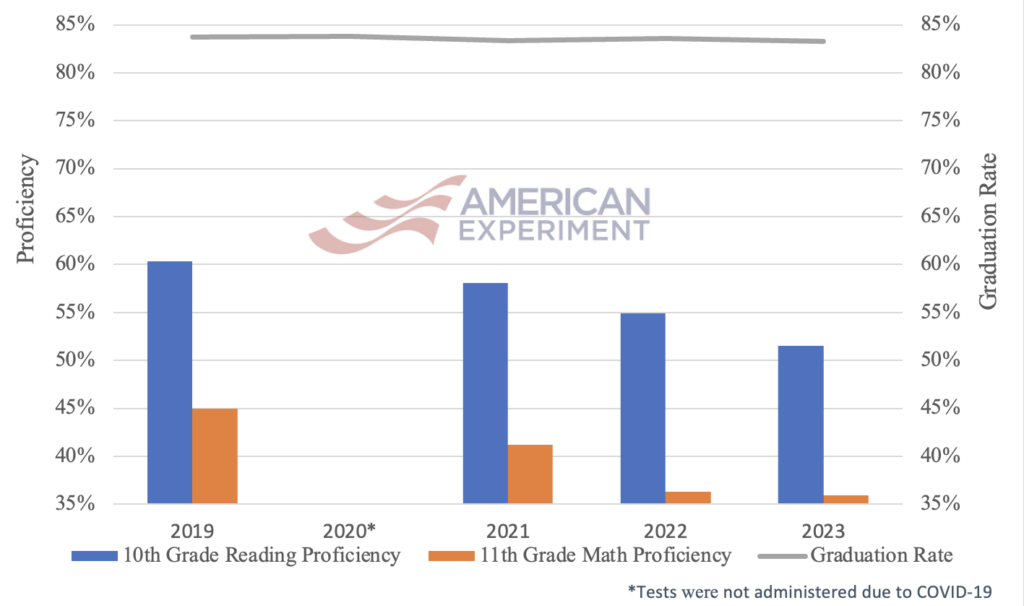
Graduation rates have held fairly steady over the years, despite high school proficiency declines. Additionally, Minnesota ACT scores continue to drop.
Minnesota Four-Year Graduation Rate from 2019-2023 & High School Proficiency
“Steady” test scores and achievement results that aren’t significantly different from years prior are, of course, better than sharp declines (also familiar to the state). But it is clear that mediocrity still rules, and the first step is being honest that this isn’t good enough. Without innovative policy measures — including those that expand the entrepreneurial marketplace of goods and services in education and introduce competition to a system that is fundamentally uncompetitive — Minnesota risks continuing such unsustainable and unacceptable performance results.