St. Paul school district asks voters to approve tax increase to help cover anticipated budget shortfall
With an anticipated $37 million budget deficit beginning in the 2026-27 school year, the St. Paul school district is asking voters to take on more property taxes for the next 10 years by passing an operating levy this November to cover the shortfall.
In a recent interview with KSTP, Superintendent Stacie Stanley said “the additional funding wouldn’t cover anything new” but is funding the district needs to “maintain operations.” According to KSTP:
The superintendent said her district has trimmed all the fat it can. Prior to her hire, previous district leadership reduced administration, human resources and some programming for students, she said.
“And that was difficult because community members came in, they spoke and they talked about what a difference those programs made for their students, and yet, for next year, they had to make those reductions already,” Stanley said.
Between this past school year and the one starting in the fall, she said the district made $165 million worth of budget cuts.
Still, the superintendent said they’re looking at a $37 million shortfall for the 2026-2027 school year, and she largely blames a lack of state funding.
“Had it kept up with inflation over the past couple of decades, St. Paul Public Schools would have $50 million more in funding,” Stanley said.
Combined revenue per adjusted average daily membership (ADM) for the St. Paul district has increased 73.5 percent from FY 2003 to FY 2023 — a 20-year period — and has exceeded inflation (Consumer Price Index) by 7.9 percent over that same time period. Meanwhile, the district’s average daily membership has decreased 38 percent over those 20 years.
| St. Paul School District | FY 2003 | FY 2023 | % Change |
| Average Daily Membership (ADM) | 43,656 | 31,611 | (38.10%) |
| Combined Revenue per ADM | $9,480 | $16,449 | 73.51% |
| Consumer Price Index (CPI) | 184.0 | 304.7 | 65.60% |
American Experiment Marketing & Communications Director Bill Walsh predicted just last year the district would face budget challenges. Remember the Circle of Education Funding? There is a key number that impacts a district’s financial situation, yet it isn’t often (if ever) brought up when discussing financial woes — the cost of a new union contract.
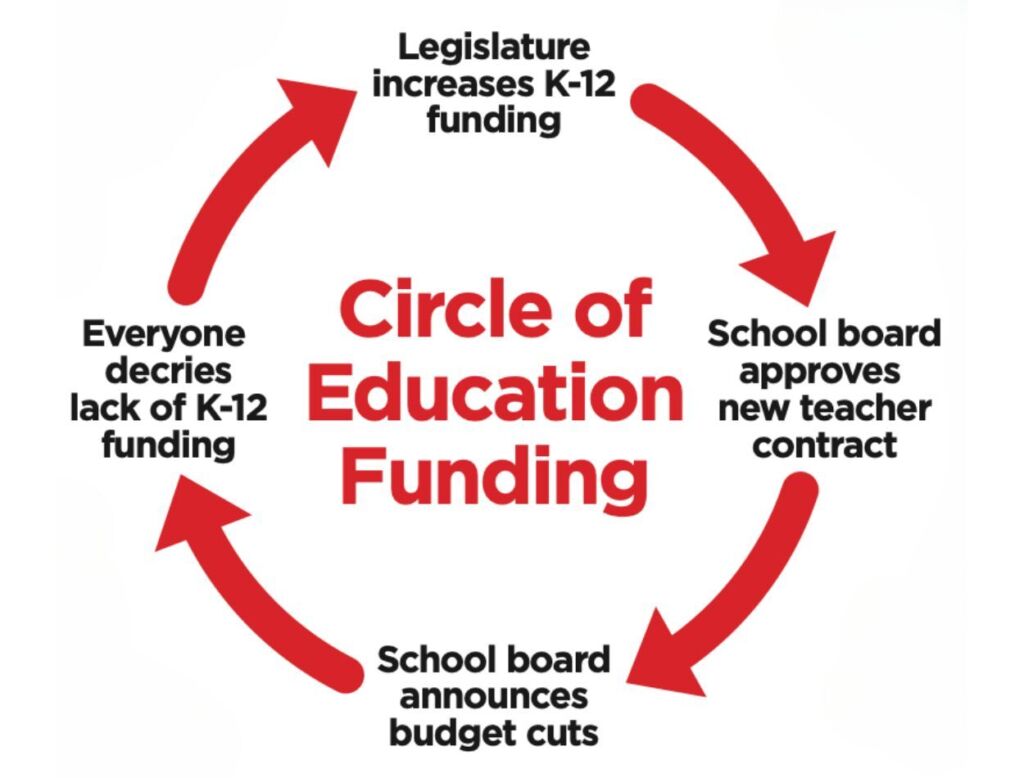
First, the Circle starts off with the Minnesota Legislature increasing K-12 education funding. During the 2024 legislative session, St. Paul received $56 million in new money. Step 2 of the Circle of Education Funding is the new collective bargaining contract the district and union agree on — in St. Paul’s case, around $112 million of new funding was needed to cover what the union was pushing for, which is more than the district received from the state. This brings us to Step 3: Cuts are needed to pay for the new union contract that the district can’t afford because the district was already in the hole before the new contract was even agreed upon, which for St. Paul was over $100 million. Then, Step 4, everyone decries the lack of K-12 education funding. And the Circle of Education Funding starts all over again.
The district states the operating levy is needed “to continue providing high-quality education to all of our students” and to “help protect our academically challenging and engaging programs so every student can access the opportunities they deserve.” Most recent achievement data as measured by the Minnesota Comprehensive Assessments shows 25.5 percent of students meet grade-level benchmarks in math and 34 percent meet grade-level reading proficiency. (Note: Participation on these assessments is over 90 percent and opt-outs are not factored into proficiency results.)