Minnesota cannot keep expanding spending on assistance programs
On January 26, Gov. Tim Walz introduced his tax and spending plan. Among other things, the plan proposes to raise both the corporate and income tax rates, the revenue of which will pay for increased spending on programs assisting individuals and businesses that have been affected by the coronavirus pandemic.
Walz has proposed a one-time payment of $750 to low-income individuals. The payments will come through the Minnesota Family Investment Program (MFIP), which oversees Minnesota’s cash payment program. This is very much in line with an earlier proposal to give cash payments to welfare recipients.
But while the proposal is well-intentioned, there are a number of things Walz and other lawmakers should keep in mind.
Minnesota is already very generous
As outlined in our report, Minnesota is an exceptionally generous state when it comes to welfare programs. In 2018, for instance, Minnesota spent approximately $30,000 per person in poverty on public welfare — the third-highest rate in the nation. The national average spending was only $17,000 per person.
Quite understandably, welfare does include some high-cost services like healthcare, which partially contribute to such high expenditure. However, upon further inspection, it does not explain why we spend much higher compared to other states. In fact, on healthcare services included in welfare, like Medicaid, Minnesota also spends more on average than most states.
The same is true with cash welfare payments. In addition to having high payments, Minnesota also has lax eligibility standards. In 2018, Minnesota had the highest income eligibility cutoff in the entire country. Additionally, Minnesota’s monthly cash payments were significantly higher than the national average.
Figure 1: Maximum Monthly Earnings for Initial TANF eligibility for a Family of three (2018)

Most growth in spending has come from welfare
Not surprisingly, spending on welfare takes up a big chunk of our budget. From 2010 to 2018, spending on welfare made up at least 30 percent of the Minnesota budget every year. In 2018, welfare spending was 37.10 percent of general fund expenditure.
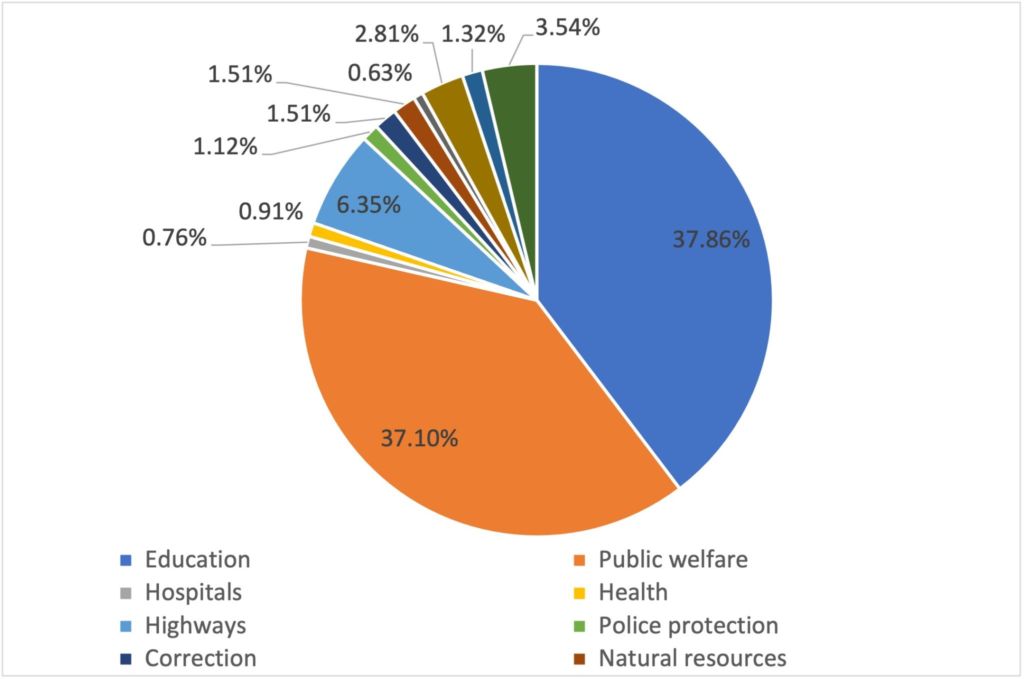
Source: US Census Bureau
Not only that, but between 2010 and 20198, welfare expenditure has grown by 30 percent. Welfare has been the fastest-growing expenditure in our budget, accounting for a little over 50 percent of growth in general fund spending.
So, setting aside the fact that most welfare recipients saw no disruption in cash payments, there are a number of reasons that make expanding welfare due to the pandemic illogical.
For one, Minnesota is an extremely generous state when it comes to welfare spending. Additionally, welfare takes up a big and increasing chunk of our budget. The pandemic should be no excuse to overwhelm our budget with increased spending on assistance programs.