California Legislature amends pro-worker law after influx of requests for exemption
On August 18 last year, the California Governor signed Assembly Bill N0.5 (AB5) into law. This law essentially limits an employer’s ability to classify workers as independent contractors by restricting the guidelines used to determine who can be labeled as an independent contractor. With a few exemptions, anyone not able to meet specified guidelines is expected to receive the same benefits and protections as a regular employee.
When the law was passed, it was championed as a victory for the working people. However, the law started squeezing the same people it was meant to help. I previously wrote about Vox Media, which after championing the law, announced it was going to cut jobs. Other individuals who wished to work independently also worried that being classified as employees would mean losing scheduling flexibility.
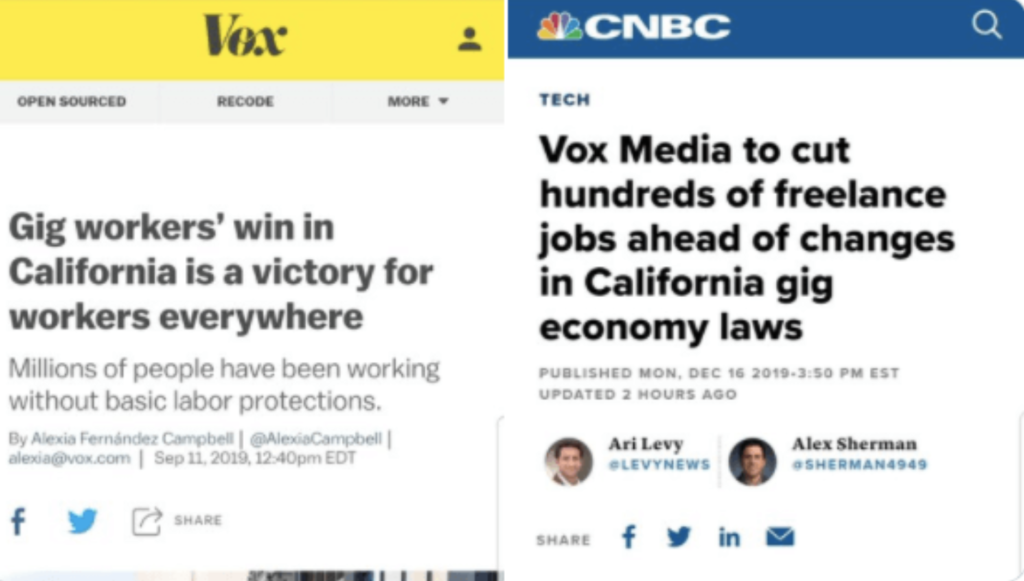
A year later, new amendments were added to the list of exempted professions
More than a year later since the law was passed, it is easy to see that it has failed to achieve its intended purposes. But instead of admitting this policy failure, legislators have made numerous amendments, providing exemptions to professions that have called for them.
According to Mintz, California has had to develop a less restrictive test for employees and contractors to assess their exemption eligibility.
California has amended its independent contractor law to make more jobs and professions exempt from the “ABC” test that AB 5 codified last year. Governor Newsom signed the amendment into law on September 4, 2020. It becomes effective immediately.
AB 2257 modifies and expands the list of professions exempt from the “ABC” test to include additional occupations and industry areas. These changes primarily impact freelance writers, musicians, film support crews and visual artists, making it easier for companies to classify them as independent contractors.
With these amendments, roughly 75 professions or types of businesses are now exempt from the independent contracting test set out in AB 5, meaning employers are able to use the common law Borello test instead of the more restrictive “ABC” test to assess whether the workers are employees or independent contractors.
Judging policy by intentions instead of results
Whether lawmakers did not foresee these negative consequences or decided to overlook them for the greater good, is hard to say. But this was predictable. Raising costs for contractors was bound to lower employment and freelancing.
So many professions like truckers realize this and are asking for exemptions to save their livelihoods. The Recording Academy, which had a big role in amending the law to exempt music makers from the bill also knew the unintended effects that the bill would have on workers in that industry.
What we have here is a classic example of progressive policy coming to terms with economic reality. A policy intended to help people does not always achieve its intended purpose. However, like most policymakers, instead of repealing a law that does not work, the California legislature would rather add dozens of arbitrarily decided amendments, adding to its list of exempted professions, while still expecting other employers to observe those very same burdensome laws.