Literature on childcare says strict regulation=higher prices
Minnesota is one of the most expensive states for childcare. Not only that, but childcare is also hard to find due to a shortage of space. The coronavirus has made this crisis worse. Something must be done.
Luckily, the literature on childcare is clear on what needs to be done. Specifically, the evidence presented by most research shows that high costs and shortages in childcare are heavily a result of strict regulation. Therefore, to solve this crisis, Minnesota should look into deregulating the childcare industry.
Regulation and the cost of childcare
One of the most recent studies on the regulation of childcare is a study by Diana Thomas and Devon Gory. The authors of this study found evidence suggesting that,
regulations intended to improve the quality of child care often focus on easily observable measures, such as group sizes or child–staff ratios, that do not necessarily affect the quality of care but do increase the cost of care
According to the authors, childcare regulation can be divided into two: (1) structural measures and (2) process measures. Structural measures involve easily observable characteristics like child-to-staff ratio, group sizes, teacher education requirements, and program administration. Process measures, however, are hard to observe and focus on the quality of interactions between a teacher and children in daycare.
Generally, structural measures are not closely associated with quality. However, licensing agencies put a heavy emphasis on these because they are easily observable. However, by focusing on these structural measures, regulating bodies subject providers to restrictions that limit supply, raise costs, and therefore lead to higher costs of childcare services.
In fact, estimations from the study suggest that loosening some of these restrictions would lead to lower prices in childcare.
Increasing the child–staff ratio by allowing more children per teacher reduces child care costs across all models tested. For example, an increase in the child–staff ratio requirement for infants by one infant is associated with a decrease in the cost of child care of between 9 and 20 percent across all models, which would reduce the annual cost of child care by between $850 and $1,890 per child across all states, on average.
Other studies
Other studies do provide evidence that shows similar results. A study published by the American Institute for Economic Research (AIER) found that states that have stricter regulation (as per Cato’s Regulatory Ranking) have higher childcare costs compared to those with less strict regulation.
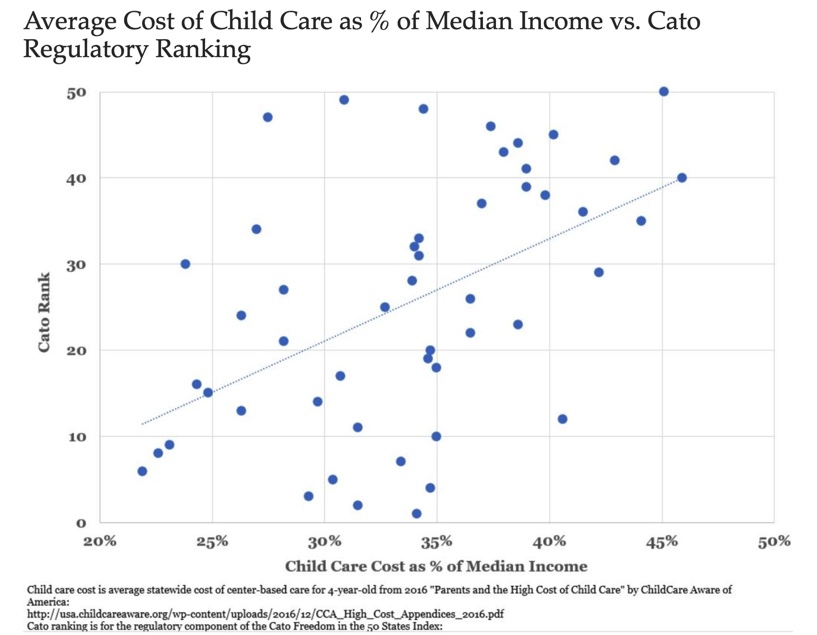
Randal Heeb and Rebecca Kilburn (2004) also found evidence showing strict childcare ratios raise the price of care at centers and drive other parents to unregulated lower-quality care. In some instances, high prices are responsible for keeping mothers out of the workforce completely. Other studies have found detrimental impacts of strict regulation on other aspects of childcare like supply (Joseph Hotz and Mo Xiao 2011) and workers’ wages (David Blau (2007).
Conclusion
Proponents of strict childcare regulation in Minnesota usually argue that Minnesota’s stringent rules are responsible for high-quality childcare. However, evidence shows that this is not the case.
Most measures that the Minnesota Department of Human Services (DHS) uses to analyze quality like child-staff ratios and group sizes have no discernible effect on quality. Instead, they only work to raise prices for parents and make it harder for providers to make profits.